There is a particular kind of manager I have watched destroy teams. Not through malice — through velocity. He arrives at a new company with fourteen ideas in the first week. By week three he has reorganized the department, cancelled two ongoing projects, and launched three new initiatives. His energy is extraordinary. His confidence is magnetic. People are excited. By month four the department is in chaos. Half the team has quit. The projects he cancelled were generating revenue. The initiatives he launched were not resourced properly and are failing visibly. When confronted, he does not pause. He accelerates. New plan. New restructure. More speed. He genuinely believes the problem is insufficient momentum.
He is wrong. The problem is that momentum without direction is just violence with a schedule.
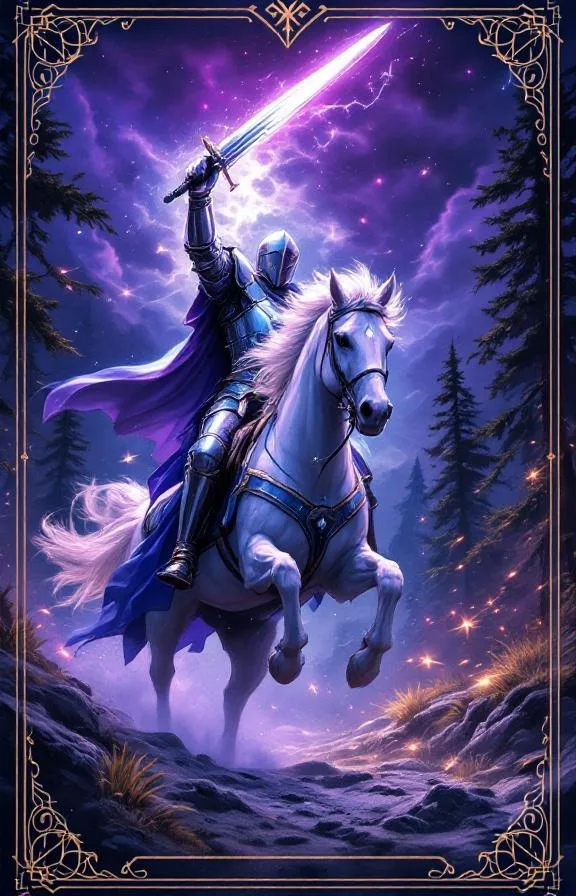
That is the Knight of Swords reversed. Not someone who lacks drive — someone whose drive has disconnected from strategy, from empathy, from the basic human requirement to stop and think before acting.
In short: The Knight of Swords reversed embodies aggression untethered from purpose — rushing forward so fast that thinking becomes impossible, confusing speed with progress, and burning out everyone around them in the process. Stanley Milgram's obedience experiments revealed how easily people abandon independent moral judgment under pressure; the reversed Knight creates exactly that kind of pressure, demanding others follow a pace that leaves no room for questioning whether the direction is right.
Why Knight of Swords appears reversed
The upright Knight of Swords is the most intellectually aggressive card in the deck. He rides fast, thinks fast, speaks fast. When this energy works — and it does work, sometimes brilliantly — it cuts through procrastination, indecision, and bureaucratic sludge like a blade through paper. Problems get solved. Decisions get made. Things happen.
The reversal keeps the speed. It removes the aim.
Picture a sword swinging at full force with no target. That is not combat. That is a hazard. The reversed Knight does not stop fighting. He cannot, because stopping would require the kind of self-reflection his personality structure is designed to avoid. Slowing down would mean sitting with uncomfortable questions: Is this the right direction? Am I helping or damaging? Do I actually know what I am doing, or am I substituting confidence for competence?
Milgram's research is relevant here in a specific and uncomfortable way. His experiments showed that ordinary people will administer what they believe are dangerous electric shocks to strangers when an authority figure insists. The mechanism is not cruelty — it is the suspension of independent judgment under conditions of pressure and momentum. The reversed Knight creates this dynamic around himself constantly. His certainty, his speed, his unwillingness to entertain doubt — these function as a pressure system that suppresses the critical thinking of everyone in his orbit. People stop asking whether the plan makes sense because the plan is already in motion and questioning it feels like disloyalty.
Knight of Swords reversed in love and relationships
Romantic relationships with the reversed Knight have a recognizable arc. It starts with intensity that feels like passion. He pursues you like you are the only interesting thing in the world. Texts constantly. Makes plans. Says things that feel big — not after months of building trust, but immediately. Week one. This speed can be intoxicating.
Then you notice: the intensity is not personal. It is constitutional. He would bring this same energy to any pursuit. You are not being loved — you are being acquired. The difference becomes apparent when you need something slow from him. A conversation about your feelings. A quiet evening without plans. Patience with your process of decision-making. He cannot do it. Slowness physically agitates him. Your need for pace feels like resistance, and resistance triggers aggression.
If you pull this card about yourself in a love reading, the question is not whether you care about your partner. You probably do. The question is whether your version of caring looks like caring to them or whether it looks like being managed by someone who needs to control the tempo of everything.
The reversed Knight in a relationship spread sometimes also flags verbal aggression. Not shouting, necessarily. More the conversational equivalent of a blitz attack — dominating every discussion, cutting off responses, turning disagreements into debates to be won rather than differences to be understood. Being right becomes more important than being kind. That priority is the reversal in action.
For people leaving a relationship with a reversed Knight personality, one word: decelerate. Your nervous system has been running at their speed. You need time to find your own again. The quiet after the storm is not emptiness. It is your natural rhythm returning.
Knight of Swords reversed in career and finances
The workplace is where the reversed Knight does his most visible damage. Fast decisions made with incomplete information. Projects launched before the previous ones are finished. Communication that prioritizes urgency over accuracy. The email sent at 11 PM that could have waited until morning but was fired off in a burst of restless energy, creating panic in people who did not need to panic.
The most destructive career manifestation of this card is the person who equates busy with productive. Their calendar is full. Their to-do list is legendary. They work weekends. They answer emails during their kid's soccer game. And when you examine their actual output — the work that moved the organization forward meaningfully — it is less than the output of the quiet person who works focused hours and goes home at five.
Financially, the reversed Knight is the impulse investment. The stock bought on a tip without research. The business expense justified by "we need to move fast" that turns out to be a waste. There is a particular flavor of financial recklessness that disguises itself as strategic boldness. The reversed Knight is fluent in this disguise.
If this card appears in a career reading about your own behavior, take it seriously. Burnout is not a badge of honor. It is the Knight of Swords reversed catching up to you. Your body keeps score even when your calendar does not.
Knight of Swords reversed as personal growth
Growing out of reversed Knight energy is one of the hardest transformations in the tarot, because the quality that needs changing — relentless forward motion — is the same quality that makes changing feel impossible. You cannot charge your way into slowing down. The paradox is the lesson.
Milgram's experiments have a detail that rarely gets mentioned in popular summaries. Some participants did refuse to continue. They stopped administering shocks. What distinguished them was not personality type or moral superiority — it was a specific cognitive skill. They paused. In the midst of the experiment's momentum, with the authority figure insisting they continue, they created a gap between stimulus and response. They stopped long enough to think.
That gap is what the reversed Knight needs to cultivate. The space between "I have an idea" and "I am implementing the idea." The breath between hearing something you disagree with and responding. The moment of asking "should I?" before defaulting to "I can, so I will."
This growth does not require becoming passive. The Knight of Swords has extraordinary energy, and that energy is valuable. What it requires is developing the infrastructure to direct that energy — strategy, patience, the willingness to be informed by people who think slower than you but often think deeper.
One pattern I see repeatedly: the reversed Knight has been moving so fast for so long that stillness feels genuinely threatening. Sitting with an unresolved problem without immediately attacking it triggers anxiety that can feel existential. The growth work is learning to tolerate that anxiety. To sit in the question rather than rushing to an answer. The answer will still be there after you think about it. And it will be better.
How to work with Knight of Swords reversed energy
Before making any significant decision this week, wait twenty-four hours. Not because the decision needs twenty-four hours. Because you need to practice the act of waiting. The reversed Knight's muscle memory says "decide now." Overriding that muscle memory, even once, begins to build a new pattern.
Ask someone you trust to tell you, honestly, whether your pace exhausts them. Listen to their answer without defending yourself. This will be one of the most difficult things you do this month. Do it anyway.
Start a practice of writing down your plan before executing it. Not a detailed business plan — a paragraph. "Here is what I want to do, here is why, here is what could go wrong." The act of writing forces a pace that verbal processing does not. You cannot write as fast as you can talk, and that built-in deceleration gives your judgment time to catch up with your impulse.
If you manage people, review your last five directives. How many included the phrase "ASAP" or its equivalent? How many were genuinely urgent? If you are honest, probably fewer than half. The reversed Knight creates artificial urgency because real urgency feeds his sense of importance. Recognizing this pattern is the first step toward breaking it.
Try an experiment: spend one full day doing nothing that is not already scheduled. No new initiatives. No spontaneous emails. No last-minute additions to anyone's workload. Just execute what is already planned. Notice how this feels in your body. If it feels like dying, you have found the core of the problem. The reversed Knight has confused motion with meaning, and when the motion stops, meaning threatens to collapse. The experiment proves that it does not. The world keeps turning on the days you do not push it.
Physical exhaustion helps more than you expect. Not exercise as self-optimization — genuine fatigue. Hike until your legs shake. Swim until your arms are heavy. The reversed Knight lives in his head, and his head is a war room. Putting the body in charge for an afternoon interrupts the command loop. You cannot plan a hostile takeover when you are focused on the next step up the trail.
Frequently asked questions
Is the Knight of Swords reversed always about aggression?
Not always overt aggression, but always about force applied without sufficient thought. Sometimes it manifests as passive-aggressive communication, intellectual bulldozing in conversations, or simply making decisions that affect others without consulting them. The aggression can be subtle. The impact rarely is.
Can this card represent burnout rather than recklessness?
Yes — and often the two are the same thing. The reversed Knight runs until the fuel runs out, then runs on fumes, then collapses. If this card appears in a reading about exhaustion, it is diagnosing the behavior that caused the burnout, not just the burnout itself. Recovery requires changing the pattern, not just resting and then resuming the same pace.
How is the Knight of Swords reversed different from the Chariot reversed?
The Chariot reversed is about lost control — internal forces pulling in opposite directions, willpower failing. The Knight of Swords reversed has plenty of control and direction. The problem is that the direction is wrong, the speed is unsustainable, and the Knight refuses to recognize either issue. The Chariot reversed feels stuck. The Knight of Swords reversed feels unstoppable — which is precisely the problem.
Explore the Knight of Swords' full meaning, see what it reveals as feelings, or discover the Knight of Swords as a person. Ready for deeper insight? Try a free reading.