She was the smartest person in every room she entered, and everyone in those rooms knew it within thirty seconds. Not because she announced it. She did not need to. It was in the way she listened — with an evaluative stillness that made you feel like your words were being graded in real time. She gave precise feedback at work. She never said anything inaccurate. Her assessments of people and situations were surgically correct. And over four years, every close friend she had slowly stopped calling.
I asked one of them why. "Being around her is like living inside a performance review," she said. "She is never wrong. That is the worst thing about her. She is never wrong, and she never lets you forget it, and eventually you realize that being right is the only thing she knows how to be."
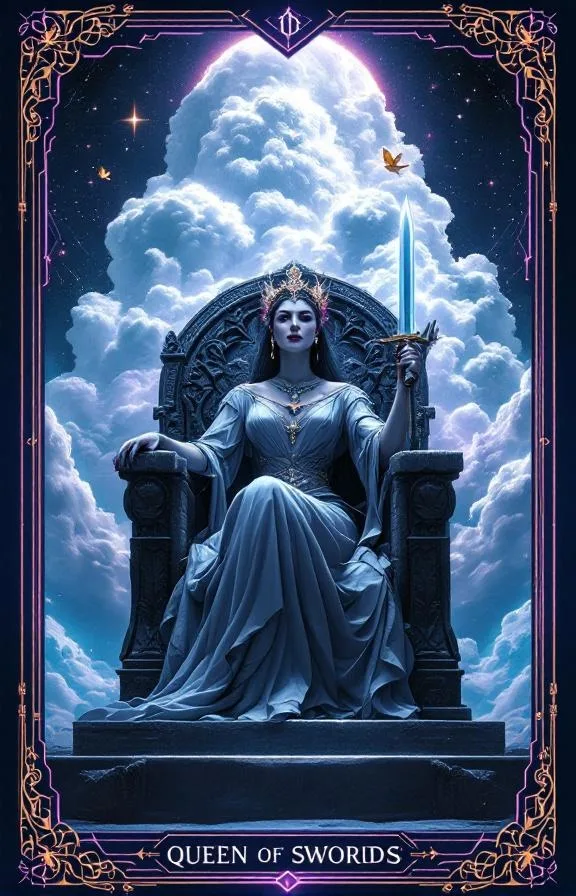
The Queen of Swords reversed does not lose her intelligence. She loses the warmth that makes intelligence bearable. What remains is a blade with no handle — effective for cutting, impossible to hold without getting hurt.
In short: The Queen of Swords reversed represents intellect weaponized against connection — sharp perception turned bitter, healthy boundaries calcified into walls, and truth delivered without any consideration for the person receiving it. Judith Herman's research on complex trauma illuminates why: hyper-vigilant boundary enforcement often originates as a survival strategy, protecting against further hurt, but eventually isolates the very person it was designed to keep safe.
Why Queen of Swords appears reversed
The upright Queen of Swords is one of the most admirable figures in the tarot. She has been through pain — the biographical tradition gives her widowhood or loss — and emerged with clarity rather than bitterness. She sees people honestly. She communicates directly. She does not sacrifice truth for comfort, but she delivers truth with enough compassion that it lands as insight rather than injury.
Reverse her, and the balance tips. The clarity remains. The compassion does not.
Herman's work on trauma — particularly her concept of complex PTSD — provides the framework for understanding why. People who have been hurt repeatedly, especially in intimate relationships, develop protective strategies. Emotional hypervigilance. Preemptive distance. The assumption that vulnerability equals danger. These strategies work. That is the problem. They work so well at preventing further injury that the person using them mistakes the strategy for the self. "I am independent" replaces "I learned to survive alone." "I am realistic about people" replaces "I was hurt enough times that I stopped expecting kindness."
The reversed Queen has built a fortress of logic. The moat is sarcasm. The drawbridge never comes down. She watches the world from her tower with perfect visibility and absolute solitude. She would tell you she prefers it this way. She is lying. Not deliberately. She has repeated the lie long enough that it has become indistinguishable from belief.
Queen of Swords reversed in love and relationships
This card in a love reading is one of the most difficult messages the tarot delivers, because it identifies a pattern that is almost invisible to the person running it.
If the reversed Queen represents you: your standards are not the problem. Your communication style is. You believe you are being honest. You are. But honesty without warmth is just cruelty with better vocabulary. When your partner shares a vulnerability, do you hold it or analyze it? When they make a mistake, do you help them recover or do you catalogue the error for future reference? These are not rhetorical questions. Your answers determine whether your relationship survives.
The reversed Queen of Swords in love often describes someone who was deeply hurt by a previous relationship and responded by constructing an elaborate system of emotional controls. They decide in advance how much they will invest. They keep score. They withdraw at the first sign of potential disappointment — not because the current partner has done anything wrong, but because someone else did, years ago, and the reversed Queen has sworn it will never happen again. The cost of this oath is connection itself.
For people in relationships with a reversed Queen personality, understanding the origin does not make the experience less painful. Knowing that her coldness comes from trauma does not make the coldness warm. What it does offer is a framework: this person is not being cruel because they do not care. They are being cruel because caring has historically been punished, and they are doing the only thing their nervous system knows how to do when intimacy gets close.
If you are single and pull this card, examine whether you are actually looking for a partner or looking for evidence that partnership is not worth the risk. The reversed Queen can spend years on dating apps, rejecting everyone for minor flaws, and calling it "knowing what I want." It is not. It is fear wearing the mask of discernment.
Queen of Swords reversed in career and finances
In the workplace, the reversed Queen is brilliant and impossible. She delivers results. She also delivers feedback that makes people cry in the bathroom. She does not understand why both of those things can be true simultaneously — or rather, she understands intellectually but considers emotional responses to be the other person's problem to manage.
This manifests as the manager whose team produces excellent work and has 200% turnover. The colleague whose emails are technically professional and leave you feeling two inches tall. The mentor who gives advice so blunt it feels like being hit. In each case, the intelligence is real and valuable. The delivery makes it inaccessible.
Financially, the reversed Queen is often extremely competent but rigid. Her budget is meticulous. Her investments are researched. Her financial planning is airtight. The reversal shows up in generosity — or its absence. She cannot spend freely on others because spending feels like vulnerability. A gift creates an obligation. An obligation creates a dependency. A dependency creates a point of leverage that someone could use against her. This chain of reasoning is so fast and so automatic that she does not even notice it happening. She just feels uncomfortable when someone suggests splitting dinner.
Queen of Swords reversed as personal growth
The growth work for the reversed Queen is terrifyingly simple: let someone in.
Not all the way in. Not immediately. Herman's therapeutic framework is explicit about this — trauma recovery does not involve dropping all defenses at once. That would be retraumatizing. The process is gradual. You open one door. You see what happens. If what happens is safe, you consider opening another. The reversed Queen needs to learn that safety is possible, and the only way to learn it is through experience, not theory.
Here is where I will say something that the reversed Queen will find objectionable: emotional intelligence is a form of intelligence. It is not a lesser skill. It is not "soft." It is the capacity to navigate human relationships with the same rigor and precision that the reversed Queen brings to intellectual problems. And it is learnable. The Queen of Swords reversed is not emotionally unintelligent. She is emotionally defended. The intelligence is there, behind the wall. She suppressed it because it was the thing that got her hurt.
Growth for this card involves grief. Real, ugly, inconvenient grief. For the relationships that hardened her. For the years spent in the fortress. For the version of herself that could receive tenderness without flinching. That version still exists. She is not gone. She is armored. The growth process is removing the armor piece by piece, in the company of someone trustworthy, at a pace the nervous system can tolerate.
The reversed Queen often fears that softening will make her weak. This is the core delusion. The upright Queen is proof: you can be sharp and kind. Direct and warm. Honest and gentle. These are not contradictions. They are the integration of qualities the reversed Queen has separated into "strength" and "vulnerability," filing the first as necessary and the second as dangerous.
How to work with Queen of Swords reversed energy
The next time you are about to deliver a piece of honest feedback — to a partner, a colleague, a friend — pause and ask yourself: what do I want this person to feel after hearing this? If the answer is "better informed," add a second goal: "and still connected to me." Then adjust your delivery accordingly. The information can stay the same. The packaging matters more than you have been willing to admit.
Practice receiving compliments without deflecting them. When someone says something kind about you, respond with "thank you" and nothing else. No qualifier. No joke. No redirect. Just "thank you." Sit in the discomfort. The discomfort is the wall registering that someone got close, and the absence of counter-attack is new data for your nervous system.
Identify one person in your life who has stayed despite your edges. Not because they are codependent or because they need something from you — someone who genuinely chooses to be present. Ask yourself why they stay. The answer will tell you something about yourself that your self-image has been screening out.
Write down three things you need from other people. Not three things you provide. Three things you need. If this exercise makes you nauseous, you have found the wound. Stay with it.
Notice when you use sarcasm. Not to eliminate it — the reversed Queen's wit is genuine and often brilliant. But notice when the sarcasm is a substitute for a direct emotional statement. "Oh, wonderful, another family dinner I'll enjoy immensely" means "I dread seeing my family and I do not know how to say that sincerely." Sarcasm is the moat. Start building a bridge alongside it. Keep the moat if you want. But build the bridge too.
Frequently asked questions
Does the Queen of Swords reversed mean I am a cold person?
Not inherently cold, no. It means you are using coldness as protection — and the protection has become so habitual that it feels like personality. The distinction matters because personality feels permanent, while protective strategies can evolve. The warmth the reversed Queen has suppressed is still there. Accessing it requires feeling safe enough to lower defenses, which is a process, not a switch.
Can this card represent someone being deliberately manipulative?
It can, though manipulation is not its primary meaning. When the reversed Queen does manipulate, she does it through information — withholding key details, using what she knows about someone's insecurities to control outcomes, deploying silence as punishment. The manipulation is cerebral rather than emotional. If surrounding cards suggest deception, take this reading seriously.
What is the relationship between the Queen of Swords reversed and the Queen of Cups reversed?
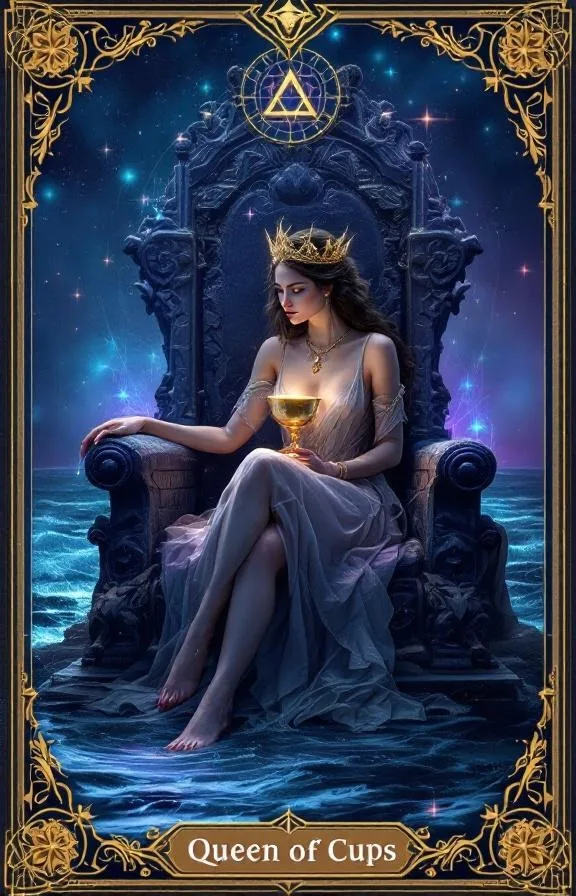
They are distorted mirrors of each other. The Queen of Swords reversed has too much head and not enough heart — intellect without empathy. The Queen of Cups reversed has too much heart and not enough structure — emotion without boundaries. Both represent imbalance, but the texture of the suffering is completely different. The reversed Queen of Swords is lonely from behind her walls. The reversed Queen of Cups is overwhelmed because she has none. Each card holds the medicine the other needs.
Explore the Queen of Swords' full meaning, see what it reveals as feelings, or discover the Queen of Swords as a person. Ready for deeper insight? Try a free reading.