A law professor I studied under had a teaching method that everyone praised as rigorous. He would call on students without warning, dismantle their arguments in front of the class, and frame the humiliation as a gift — preparation for the adversarial system, he said. He quoted Socrates. He talked about the forge of intellectual combat. He produced graduates who could argue anything and believe nothing.
Years later, I met two of his former students at separate events. Both successful attorneys. Both described the same experience independently: they had internalized his voice so completely that they could no longer have a disagreement with a spouse or friend without automatically constructing the opponent's case and prosecuting their own argument to win. One of them said, "He taught me to think like a lawyer. The problem is I cannot stop." The other said something shorter. "He broke something in me that I'm still trying to fix."
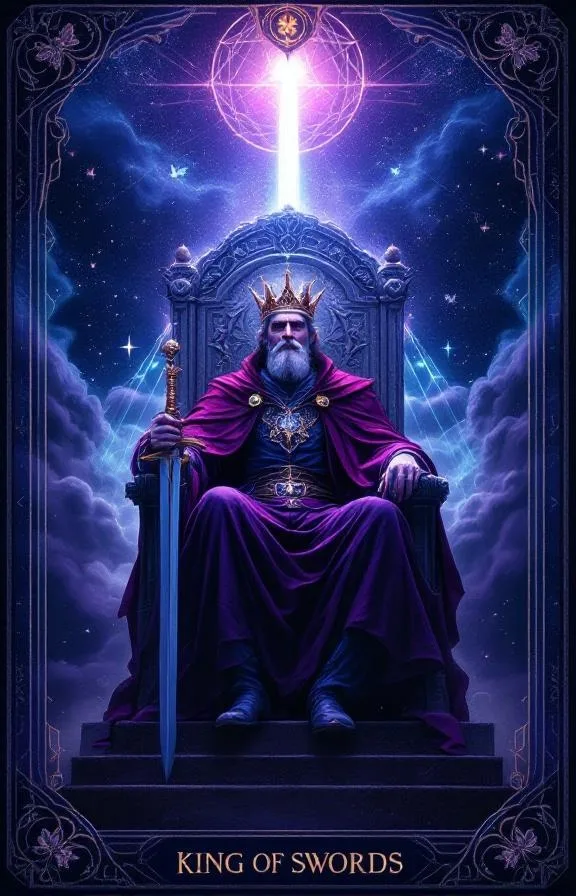
That professor is the King of Swords reversed. Authority built on intellectual power used to dominate rather than serve. The sharpest mind in the room, pointed at everyone else.
In short: The King of Swords reversed represents intellectual authority corrupted — logic used as a tool of control, moral reasoning bent to serve personal power, and the cold weaponization of clarity against those with less rhetorical skill. Lawrence Kohlberg's stage theory of moral development describes the framework: at the highest stages, moral reasoning serves universal principles; at lower stages, it serves the self, dressed in the language of principle to disguise the self-interest underneath.
Why King of Swords appears reversed
The upright King of Swords is the most ethically grounded authority figure in the deck. He rules through reason. His judgments are impartial. He separates emotion from decision-making not because emotion is unimportant but because the moment of judgment requires clarity. He is the ideal judge: fair, informed, decisive, accountable to principles larger than himself.
Reverse him, and every one of those qualities turns toxic. Reason becomes rationalization. Impartiality becomes indifference. Clarity becomes cruelty. Accountability evaporates. What remains is a mind of extraordinary power operating entirely in service of its own authority.
Kohlberg mapped moral development across six stages. At the highest — which few adults consistently reach — decisions are guided by universal ethical principles. At lower stages, decisions serve conventional social expectations or, worse, raw self-interest. The reversed King of Swords operates at a low moral stage while using the vocabulary of the highest. He talks about fairness while rigging the game. He invokes principle while serving ego. He argues with such skill that the contradiction is invisible to everyone, including — sometimes — himself.
This is what makes the reversed King genuinely dangerous. The less intelligent version of this corruption is easy to spot. A bully who uses force is obviously a bully. But a bully who uses logic? Who frames every act of domination as a reasoned conclusion? Who can make you feel stupid for objecting? That person can operate for decades without being challenged, because challenging them requires matching their rhetorical skill, and most people cannot.
King of Swords reversed in love and relationships
I am going to be direct about this card in love readings: if you are in a relationship with a reversed King of Swords, you are in a relationship with someone who wins every argument. Every. Single. One. Not because they are always right. Because they are always better at arguing.
The experience is disorienting. You know something is wrong. You feel it in your body — the knot in your stomach, the way your throat closes when they start their calm, measured explanation of why you are being irrational. But you cannot articulate what is wrong because every time you try, they dismantle your articulation. They do not yell. They do not need to. They simply construct arguments so airtight that your emotional reality cannot find a crack to exist in.
This is the reversed King's most corrosive relationship pattern: the systematic invalidation of emotional experience through logic. "You feel hurt? Let's examine whether that feeling is proportional to the stimulus." "You are upset about what I said? Let me explain what I actually meant, because you clearly misunderstood." Every painful feeling gets redirected into a debate about whether the feeling is justified, and since feelings are not logical propositions, they always lose.
If this card represents you in a love reading — and this is hard to hear — your partner is afraid of you. Not physically. Intellectually. They have stopped bringing up issues because every issue becomes a courtroom proceeding they know they will lose. Their silence is not agreement. It is surrender. And surrender is not love.
For people evaluating a potential partner, the reversed King sometimes appears as a warning about charm. He is articulate, confident, well-read. He can discuss anything. Conversation with him feels stimulating. But notice whether the conversation ever flows both ways. Does he ask questions and listen to the answers? Or does he ask questions and then improve on your answers? That distinction is the difference between the upright and reversed King.
King of Swords reversed in career and finances
The reversed King in professional settings is the executive who creates a culture of intellectual intimidation so thorough that no one will tell him he is wrong. His reports are flawless because three people stayed until midnight correcting them out of fear. His strategy is unchallenged because the last person who raised a concern in a meeting was humiliated so precisely that everyone in attendance learned the lesson.
The organization suffers. Innovation requires people who feel safe enough to propose ideas that might fail. The reversed King punishes imperfection so efficiently that only safe, pre-validated ideas reach his desk. The bold ones die in the hallway outside his office, killed by subordinates who know better than to present anything that might invite scrutiny.
Financially, the reversed King is often successful. His analytical skills are genuine. His understanding of systems and structures is formidable. The reversal shows not in his outcomes but in his methods. He may trade on insider knowledge and justify it through legal technicality. He may structure deals that are technically fair and practically exploitative. The letter of every law followed. The spirit of none.
If this card describes your own professional behavior, the question is not whether you are effective. You probably are. The question is what your effectiveness costs the people around you, and whether you have bothered to find out.
King of Swords reversed as personal growth
Growth for the reversed King requires something he has spent his entire life avoiding: being wrong and letting it stand.
Kohlberg's model suggests that moral development is not automatic. People do not simply mature into higher stages of reasoning through experience. They advance through genuine cognitive conflict — encountering situations where their current framework cannot produce an adequate response. The reversed King avoids this conflict by ensuring his framework always wins. His argumentative skill is so developed that he can make any framework produce any conclusion he needs, on demand.
The growth rupture, when it comes, is devastating. It usually takes the form of a loss that logic cannot process. A relationship ending despite his inability to identify a procedural error. A child who stops talking to him. A colleague he respected telling him, finally and permanently, that he is impossible to work with. The intellectual apparatus he has relied on to navigate every situation encounters something it cannot argue away: the lived experience of someone he has hurt.
Some reversed Kings respond to this by constructing an even more elaborate argument about why the other person is wrong. This is the failure mode. The growth mode is the one that feels like drowning — the moment when the sword drops and there is nothing underneath it. No argument. No defense. Just a person who caused harm and has to sit with that fact without immediately converting it into a lesson or a narrative or a strategy for improvement.
This is, in my experience, the hardest growth journey in the Swords court. The Page needs to learn humility. The Knight needs to learn patience. The Queen needs to learn vulnerability. The King needs to learn all three simultaneously, and he has to do it while dismantling the very cognitive machinery that has defined his identity for years or decades. It is not impossible. But it requires a surrender that feels, to the reversed King, like annihilation.
How to work with King of Swords reversed energy
In your next disagreement with someone you care about, try this: instead of responding to their argument, respond to their feeling. They say they are hurt. Do not ask why. Do not evaluate whether the hurt is justified. Say: "I hear that you are hurt, and I am sorry." Full stop. No explanation. No context. No reframe. Just the acknowledgment and the apology.
This will feel physically uncomfortable. Do it anyway.
Identify the last time you changed your mind about something significant because of another person's input. Not because new data emerged — because a human being you respected said something that shifted your perspective. If you cannot recall such an instance within the last year, that is the diagnosis. The reversed King learns from data, from books, from analysis. He rarely learns from people, because learning from people requires valuing their perspective as equal to his own.
Read something that makes you feel rather than think. Fiction. Poetry. A memoir. Not to analyze it. Not to evaluate its craft. To experience it. Let a story move you without immediately categorizing the emotion. The reversed King treats all input as information to be processed. Some input is meant to be felt.
Consider therapy — specifically, a therapist who will not be intimidated by your intelligence. This is harder to find than it sounds. Many therapists will be impressed by your articulation and mistake it for insight. Find one who says, gently and firmly, "You are explaining your feelings instead of having them."
Frequently asked questions
Is the King of Swords reversed always about a man?
No. Kings in tarot represent mature, established energy in their suit regardless of gender. The reversed King of Swords can describe anyone who uses intellectual authority to control or dominate — a woman, a nonbinary person, an institution. The energy is about power dynamics, not gender.
Can this card indicate legal problems?
It can. The King of Swords is associated with law and formal authority, and its reversal sometimes points to legal proceedings that are unjust, lawyers who exploit their clients, or situations where the legal system is being used as a weapon. If this card appears alongside Justice reversed or the Seven of Swords, pay careful attention to any legal matters in your life.
What is the difference between the King of Swords reversed and the Emperor reversed?
The Emperor reversed is about structural authority failing — corrupt systems, dysfunctional hierarchies, power without legitimacy. The King of Swords reversed is specifically about intellectual authority corrupted — manipulation through logic, weaponized reasoning, moral language hiding self-interest. The Emperor reversed creates bad rules. The King of Swords reversed follows every rule perfectly while violating the principles behind them. One abuses the system. The other abuses the mind. Both are dangerous, but they damage in fundamentally different ways.
Explore the King of Swords' full meaning, see what it reveals as feelings, or discover the King of Swords as a person. Ready for deeper insight? Try a free reading.