My colleague once spent an entire afternoon drafting a resignation email. He rewrote it fourteen times. Changed the tone, softened the language, added a paragraph about gratitude, deleted it, put it back. Around five o'clock he closed the laptop and said he would finish it tomorrow. Tomorrow became next week. Next week became three months. When I finally asked if he had sent it, he looked confused — as though the act of writing it had been the act of deciding. He is still at that job. The email is still in his drafts folder, unfinished, unsent. That is the Ace of Swords reversed, crystallized into a single afternoon.
There is something particularly cruel about mental clarity that almost arrives. You can feel the shape of an insight forming, the way you can feel a word on the tip of your tongue. But it will not come into focus. You circle around it. You think maybe if you read one more article, have one more conversation, sleep on it one more night. The insight stays just out of reach, and the circling becomes the thing you do instead of the thinking you need to do.
In short: The Ace of Swords reversed represents a breakdown in mental clarity — confusion masquerading as complexity, dishonesty packaged as diplomacy, or brilliant ideas that never survive first contact with reality. William James described consciousness as a "stream" of thought, continuous and flowing. When this card appears reversed, that stream has been dammed. Thoughts stagnate. What should be a breakthrough becomes a breakdown.
Why the Ace of Swords appears reversed
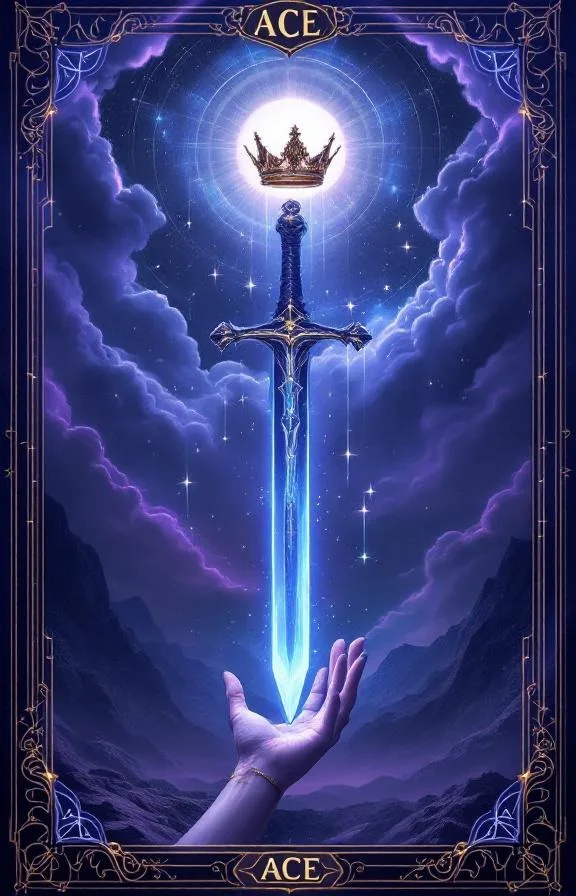
The upright Ace of Swords is arguably the most decisive card in the deck. A single blade piercing through clouds. One idea. One truth. One cut that separates what matters from what does not. When this card flips, the sword dulls. Not dramatically — not a shattered blade or a lost weapon. Just a slow erosion of edge. Ideas that felt sharp yesterday feel blurry today.
William James spent years studying the relationship between thought and action. He observed that consciousness is not a series of discrete thoughts but a continuous flow, and that mental health depends on that flow remaining unobstructed. When the Ace of Swords appears reversed, it points to an obstruction in this flow. Information comes in but does not get processed into meaning. You read the same paragraph four times and still cannot tell someone what it said.
There are three common faces to this reversal. The first is genuine confusion — brain fog, overwhelm, the inability to think clearly because there is too much noise and not enough signal. The second is intellectual dishonesty. You know the truth, but you are choosing not to see it because seeing it would require you to act. The third face is the most insidious: it is the misuse of intelligence itself. Using your mental sharpness to build elaborate justifications for things you know are wrong. Constructing arguments so airtight that nobody — including yourself — can find the flaw, even though the entire foundation is rotten.
That third face is the one most people miss. The Ace of Swords reversed is not always about being confused. Sometimes it is about being too clever for your own good.
Ace of Swords reversed in love and relationships
In romantic readings, this card usually points to a failure of honest communication. Someone is not saying what they mean. Possibly you. Possibly your partner. Possibly both of you, in a coordinated dance of evasion where neither person says the actual thing because the actual thing would change everything.
This shows up in recognizable patterns. The conversation that circles for forty-five minutes without ever arriving at its point. The text message drafted and redrafted until all the real feeling has been sanded away and what remains is so neutral it communicates nothing. The fight that is technically about dishes but is actually about something neither person has the courage or the clarity to name.
If you are single and pull the Ace of Swords reversed, the card is asking about your internal narrative. What story are you telling yourself about why you are alone? Is it true? Really true? Or is it a convenient explanation that protects you from a harder truth? "I am too busy for a relationship" is sometimes honest. Sometimes it is a shield. This card does not tell you which one it is. It just insists you ask the question.
Here is what I believe, and some readers will disagree: the Ace of Swords reversed in love almost always indicates that someone already knows the truth about their situation. The confusion is not genuine. It is performed — not consciously, not maliciously, but performed nonetheless. Clarity is available. It is just being refused.
Ace of Swords reversed in career and finances
Professionally, this card is a blinking warning light about decision quality. You are making choices based on incomplete information, flawed logic, or both. Not small choices, either — the kind that compound. Signing a contract you did not fully read. Accepting a role because it sounded impressive without understanding what it actually requires. Launching something before the concept was truly solid.
The financial dimension often involves self-deception about numbers. Estimates that are optimistic because being realistic would kill the project. Business plans built on assumptions nobody has tested. Revenue projections that only work if everything goes perfectly — and nothing ever goes perfectly.
There is a quieter version of this reversal in career readings that deserves attention. Sometimes the Ace of Swords reversed does not mean you are making bad decisions. It means you are not making decisions at all. Analysis paralysis in its purest form. James wrote about the "will to believe" — the idea that sometimes conviction must precede evidence, that waiting for absolute certainty before acting is its own kind of error. The reversed Ace lives in the space where that certainty never arrives and the paralysis becomes permanent.
Ace of Swords reversed as personal growth
Growth requires honesty, and the Ace of Swords reversed is fundamentally a card about dishonesty — with others, certainly, but primarily with yourself.
The specific flavor of self-deception this card points to is worth examining closely. It is not simple denial. Denial is crude — "there is no problem." The Ace of Swords reversed is more sophisticated. It says: "I see the problem, and here are seventeen reasons why it is not actually a problem, or why now is not the right time to address it, or why the problem is really someone else's problem disguised as mine." The intelligence that should cut through illusion instead reinforces it. The sword becomes its own sheath.
James described the pragmatic test for truth: an idea is true to the extent that it works, that it produces useful consequences when acted upon. The Ace of Swords reversed often marks a moment when your working theory of yourself has stopped producing useful consequences. The explanation you have for your own behavior does not hold up anymore. The identity you constructed feels less like a mirror and more like a mask. Growth in this context means being willing to let a cherished belief about yourself collapse, even when you have spent years building it.
This is genuinely difficult. Most people would rather be consistently wrong than publicly uncertain. The Ace of Swords reversed asks you to choose uncertainty — to sit with not knowing, to admit that the conclusion you reached was premature, to start the thinking process over from scratch. It is the mental equivalent of tearing down a building and pouring a new foundation.
How to work with Ace of Swords reversed energy
Start with the simplest possible intervention: write it down. Whatever the foggy, half-formed, uncomfortable thought is — put it on paper. Not in a notes app. Paper. There is a neurological difference between typing and handwriting when it comes to processing complex thoughts, and the Ace of Swords reversed responds to anything that forces clarity into physical form.
Then challenge your own arguments. Take the position you are most comfortable with and argue against it. Genuinely. Not as an exercise in devil's advocacy, but as an honest attempt to find the flaw you have been ignoring. If you cannot find one, ask someone who disagrees with you. Not someone who will be gentle about it. Someone who will be truthful.
The deeper work is about developing what James called a tolerance for ambiguity. The upright Ace of Swords offers clean answers. The reversed Ace insists that you sit with messy questions. Practice this: when someone asks your opinion, pause before answering. Check whether the response forming in your mouth is actually what you think or just what you think you are supposed to think. That pause — uncomfortable, awkward, sometimes socially costly — is where the Ace of Swords begins to right itself.
Frequently asked questions
Is the Ace of Swords reversed always negative?
Not always, but it is always a signal to slow down and examine your thinking. In rare cases, it can indicate a deliberate choice to withhold information for protective reasons — keeping a secret that is genuinely not yours to share, for instance. The card asks you to evaluate whether your silence serves wisdom or avoidance. That distinction makes all the difference.
What does this card mean for a yes-or-no question?
It is a no — or more precisely, a "not yet." The clarity needed to move forward with confidence has not arrived, and forcing a decision before it does will likely produce a result you regret.
How does the Ace of Swords reversed differ from The Moon in a reading?
The Moon deals with subconscious fears, illusions rising from emotional depths, the kind of confusion that belongs to the gut and the dream world. The Ace of Swords reversed is cerebral confusion — it lives in the head. The Moon asks what you are feeling underneath. The Ace of Swords reversed asks what you are thinking, or more accurately, what you are pretending to think. They can appear together in readings, and when they do, the fog is both emotional and intellectual — a thorough disorientation that requires patience rather than force to navigate.
Explore the Ace of Swords' full meaning, see what it reveals as feelings, or discover the Ace of Swords as a person. Ready for deeper insight? Try a free reading.