A former business partner of mine once answered a Slack message during his father's funeral. I know because I sent the message — a routine question about a client invoice, nothing urgent — and he replied within ninety seconds with a fully formatted answer including an attachment. I did not realize where he was until later that evening when he mentioned it casually, almost proudly, as evidence of his work ethic. He seemed to expect admiration. What I felt was something closer to horror.
He burned out eight months later. Spectacularly. Stopped answering any messages at all for three weeks, then came back and acted as though nothing had happened. The body keeps its own accounts.
In short: The Four of Swords reversed signals an inability or refusal to rest — restlessness masquerading as productivity, burnout approaching because the off switch has been disabled, or premature return to action before recovery is complete. Herbert Benson's research at Harvard on the "relaxation response" showed that the human nervous system requires deliberate downshifting to function properly, and that chronic activation without rest produces not just fatigue but measurable cognitive and physical deterioration. This card appears when that deterioration is underway.
Why the Four of Swords appears reversed
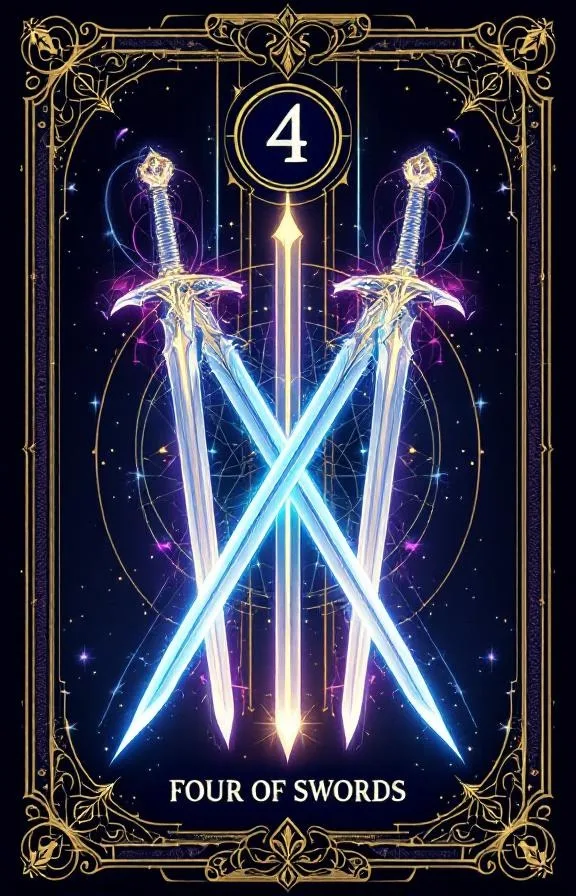
The upright Four of Swords is one of the calmest images in the deck. A figure resting in what appears to be a tomb or a quiet chapel. Three swords on the wall. One beneath the figure. The posture is not death — it is deliberate withdrawal. A strategic pause. The warrior who knows that rest is preparation, not surrender.
Flip the card and the figure cannot stay still. The retreat has been cut short. Maybe by external circumstances — a crisis that demands immediate return. Maybe by internal ones — an anxiety that makes stillness feel like failure, a nervous system so wired for threat that silence registers as danger.
Benson discovered in the 1970s that the body has a built-in counterpart to the fight-or-flight response. He called it the relaxation response: a measurable physiological state characterized by lowered heart rate, decreased blood pressure, and reduced cortisol. The critical finding was that this response does not happen automatically. It must be triggered intentionally, through meditation, deep breathing, or other deliberate practices. The Four of Swords reversed describes a person who has lost access to this trigger — or who never developed it in the first place.
There is a specific modern flavor to this card that older tarot texts do not capture. The Four of Swords reversed is the card of performative busyness. The person who cannot have an unscheduled hour. Who fills every gap with a podcast, a task, a notification. Not because the work demands it but because silence demands something they are not prepared to give. Stillness forces you to hear what you have been drowning out. The reversed Four of Swords keeps the volume up.
Four of Swords reversed in love and relationships
In relationships, this card points to a partner — or a dynamic — that will not allow for genuine rest. Someone who fills every quiet evening with plans. Who interprets a weekend without activities as a weekend wasted. Who gets anxious when the conversation pauses and immediately fills the space with words, any words.
This is subtly corrosive to intimacy. Real closeness requires shared silence. The ability to sit with someone without performing — without entertaining, without being interesting, without producing value. The Four of Swords reversed identifies a relationship where that kind of silence has become impossible, and usually one or both partners have not noticed because the busyness feels normal. It is normal. That is part of the problem.
If you are single, the reversal often indicates that you are not resting between relationships. Going from one connection to the next without a gap. Not because each new person is compelling but because the gap itself is intolerable. Being alone with your own thoughts after a breakup means actually processing the breakup, and processing it means feeling it, and feeling it means the pain is real, and if the pain is real then the loss was real, and if the loss was real then you are vulnerable, and vulnerability is the one thing the reversed Four of Swords cannot tolerate.
Here is the thing about relationships and rest that most people do not want to hear: if you cannot be peacefully alone, you cannot be peacefully with someone. You will bring the restlessness into the partnership. You will need the other person to be your distraction rather than your companion. And distractions, eventually, lose their novelty.
Four of Swords reversed in career and finances
This is the burnout card. Full stop. If you pull the Four of Swords reversed in a career reading, either burnout has arrived or it is approaching at a speed that makes its arrival inevitable without intervention.
The tricky thing about burnout is that it does not always look like exhaustion. Sometimes it looks like increased productivity — a desperate, frantic output that feels like momentum but is actually the nervous system running on fumes. The person working twelve-hour days who seems fine. Who says they love their job. Who genuinely believes they are thriving. Benson's research showed that chronic sympathetic nervous system activation can create a subjective feeling of energy even as the body deteriorates underneath it. The crash, when it comes, seems sudden only to people who were not measuring the right things.
Financially, the Four of Swords reversed sometimes indicates money decisions made from a state of mental exhaustion. Taking on clients you should have declined because the invoice justified the effort. Spending impulsively because the dopamine hit of a purchase replaced the rest you actually needed. Saying yes to every freelance opportunity because downtime without income feels irresponsible, even when the savings account is healthy. Rest has a financial component that productivity culture deliberately ignores: a rested person makes better economic decisions than an exhausted one. Every time.
Four of Swords reversed as personal growth
Growth and rest are not opposites. This is the fundamental lesson of the Four of Swords reversed, and it is the lesson most people resist most strongly.
The cultural narrative — particularly in American and Northern European contexts, but increasingly global — equates rest with laziness. Productivity is moral. Busyness is virtue. The person who sleeps five hours and answers emails at six in the morning is aspirational; the person who sleeps nine hours and starts work at ten is suspect. The Four of Swords reversed does not just reflect this narrative. It is produced by it. The card appears for people who have so thoroughly internalized the equation of worth with output that their nervous systems no longer know how to downshift.
Benson found that people who could not activate the relaxation response shared a common feature: they experienced rest as threatening. Not boring — threatening. The absence of stimulation triggered anxiety rather than relief. This is conditioned, not innate. Children naturally oscillate between intense activity and profound rest. Something happens along the way — trauma, parenting styles, cultural messaging, professional environments — that breaks the oscillation. The Four of Swords reversed names the break.
The growth practice here is almost embarrassingly simple. Do nothing. Not meditation — meditation is doing something. Not yoga, not a bath, not a walk. Nothing. Sit somewhere comfortable, set a timer for fifteen minutes, and do absolutely nothing. No phone. No music. No objective. Notice what happens in your body. The restlessness that arises is not a sign that you need to move. It is a sign that your nervous system has forgotten how to be still, and the only way to remember is to practice.
How to work with Four of Swords reversed energy
Schedule rest the way you schedule meetings. Block it in your calendar. Label it. Protect it from intrusion. If this feels absurd, that reaction is itself diagnostic — the fact that you need permission structures to do nothing tells you how far from baseline you have drifted.
Examine your relationship with productivity. Not casually — seriously. Ask yourself: if I accomplished nothing measurable today, would I still feel like a worthwhile person? If the answer is no, or if the answer comes slowly and unconvincingly, the Four of Swords reversed is doing its most important work. Your sense of self has become contingent on output. Detaching the two is not just a wellness exercise. It is the prerequisite for any sustainable way of working and living.
Create what Benson called a "breakout trigger" — a physical or environmental cue that signals your nervous system to downshift. This could be a specific chair you sit in only for rest. A particular album you play only when you are done working. A cup of tea made in a specific way. The ritual matters because the body responds to patterns. Give it a pattern for rest, and eventually rest becomes accessible again, not through willpower but through conditioning. The same nervous system that learned to stay wired can learn to unwind. It just needs repetition and permission.
Frequently asked questions
Does the Four of Swords reversed always mean burnout?
Not always, but it always means rest is being neglected in some form. In milder cases, it might indicate a period of restlessness after a necessary break — someone who has rested enough and is now ready to re-engage. Context matters. If surrounding cards are energetic and forward-moving, the restlessness may be productive impatience. If they are heavy or stagnant, burnout is the more likely reading.
Can this card appear when I am sleeping enough but still feeling exhausted?
Yes, and this is a common scenario. The Four of Swords reversed distinguishes between physical rest and mental rest. You can sleep eight hours and wake up exhausted because your mind never stopped running. The card asks about the quality of your rest, not just the quantity.
What is the difference between the Four of Swords reversed and the Nine of Wands?
The Nine of Wands describes someone who is exhausted but still fighting — battered, wary, but standing. It carries a note of resilience, of persistence despite fatigue. The Four of Swords reversed describes someone who is exhausted because they refuse to stop fighting, even when the battle is over. The Nine of Wands says you have been through something hard. The Four of Swords reversed says you are making things harder than they need to be by refusing to step away from the battlefield. Similar exhaustion, different causes, different medicine.
Explore the Four of Swords' full meaning, see what it reveals as feelings, or discover the Four of Swords as a person. Ready for deeper insight? Try a free reading.