My neighbor's dog used to bark at thunder. Not just bark — full body panic. Shaking, hiding under the bed, refusing to eat for hours afterward. His owner tried everything: thunder shirts, white noise machines, medication. Nothing worked. Then one September, a storm came through while the dog was outside, mid-chase after a squirrel. He was so absorbed in the hunt that he barely noticed the thunder. After that, something shifted. He still noticed storms. His ears would perk up. But the full-body panic never came back with the same force. His nervous system had recorded one experience of thunder-without-catastrophe, and that single data point rewrote years of conditioning.
That is the Nine of Swords reversed. Not the absence of fear. The presence of a counter-experience powerful enough to loosen fear's monopoly on your body.
In short: The Nine of Swords reversed marks anxiety's grip weakening — not through willpower or positive thinking, but through the nervous system's gradual recognition that the catastrophe it anticipated did not materialize. Peter Levine's somatic experiencing framework explains why: trauma and anxiety live in the body, not just the mind, and they release when the body completes the defensive responses it was unable to finish during the original threat.
Why Nine of Swords appears reversed
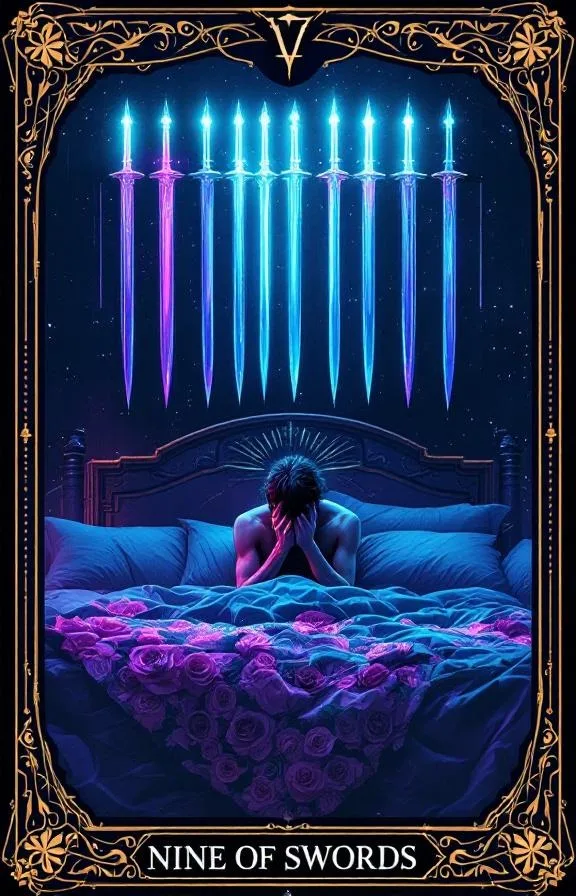
The upright Nine of Swords is the 3 AM card. Head in hands, bolt upright in darkness, nine swords mounted on the wall behind you like a catalog of every worry you carry. It is the card of anxiety at its peak — not because something terrible has happened, but because your mind is convinced something terrible will.
When this card reverses, the swords do not disappear. That is crucial. They are still on the wall. What changes is your relationship to them. The reversal marks the difference between being consumed by worry and being able to observe it. Between drowning in the dark water and realizing your feet can touch the bottom.
Levine's research into trauma resolution reveals something counterintuitive: healing from chronic anxiety is rarely a cognitive event. You do not think your way out of it. The body needs to discharge the trapped survival energy — the fight-or-flight activation that got stuck in a loop. The Nine of Swords reversed often appears after a physical release: crying that comes from nowhere and leaves you oddly peaceful, a panic attack that peaks and then subsides into genuine calm for the first time in months, a restless night that ends with deeper sleep than you have had in years.
This card is honest about what recovery looks like. It is messy. It is not linear. And it almost never looks like the movies. You do not wake up one morning free of anxiety. You wake up one morning and realize that the anxiety woke up five minutes after you did, instead of being the first thing you felt. That five-minute gap is the reversal. It widens over time.
Nine of Swords reversed in love and relationships
In relationship readings, the Nine of Swords reversed carries a very specific message: the fear that has been poisoning your connection is losing its power. Not gone. Losing power. The distinction matters.
Maybe you have spent months convinced your partner would leave. You checked their phone. You analyzed their tone of voice for signs of withdrawal. You catastrophized every delayed text. The reversed Nine suggests a crack in that pattern — a moment when you noticed your own spiral and thought, "This is my anxiety talking, not reality." That single moment of recognition changes the entire dynamic. It does not fix the relationship. It fixes the lens you have been looking through.
For people recovering from a painful breakup, this card is genuinely reassuring. The upright Nine of Swords in a post-breakup reading means the grief is still acute, the rumination still relentless. The reversal says: the worst of the emotional storm is behind you. You will still have bad days. There will be a song on the radio, a restaurant you used to go to, a Tuesday that feels exactly like every Tuesday you spent together. But the acute phase — the phase where the pain occupies every waking thought — that is ending.
Here is the hard truth this card also carries in love readings: sometimes the anxiety was not entirely irrational. Sometimes your partner was being distant. Sometimes the relationship was failing. The Nine of Swords reversed does not guarantee good news about the relationship. It guarantees better clarity about what is actually happening versus what your fear was projecting. And sometimes clarity reveals a situation you need to leave.
Nine of Swords reversed in career and finances
In a career context, this card frequently appears after a period of intense professional stress — the kind where you wake up thinking about work and fall asleep dreading Monday. The reversal signals that the pressure is easing. Maybe the difficult project ended. Maybe you had the conversation with your boss you had been avoiding. Maybe you simply hit a point where the stress became unsustainable and something in you refused to carry it anymore.
Financial anxiety has a particular quality the Nine of Swords captures perfectly: it runs in the background constantly, like a program eating up processing power without ever appearing on screen. You are at dinner with friends, laughing, and underneath the laughter there is a low hum of "but the credit card bill." The reversed card marks the moment that hum quiets. Not because the bill disappeared, but because you looked at the actual numbers instead of the imagined ones.
Most financial anxiety is worse than the financial reality. That is a bold statement and I stand behind it completely. The amount of suffering caused by imagined financial catastrophe outweighs the suffering caused by actual financial problems in the overwhelming majority of cases I have encountered. The Nine of Swords reversed says: look at your bank account. Open the statement. Do the math. The number will either be manageable or it will be a problem you can address. Either way, it will be better than the formless dread of not knowing.
Nine of Swords reversed as personal growth
The growth trajectory of this card maps almost exactly onto Levine's somatic experiencing model, and understanding that model makes the card's message much more actionable.
Levine observed that animals in the wild discharge stress responses immediately after a threatening event. A gazelle that escapes a lion will literally shake, tremble, and then walk away calm. The survival energy moves through and exits the body. Humans, with our complex social brains, often interrupt this process. We suppress the shaking because it is embarrassing. We clench against the crying because we need to be strong. We hold the tension because releasing it feels like losing control.
The Nine of Swords reversed appears when this suppression starts to break down — in a good way. The body begins to complete what it could not finish before. You might find yourself feeling emotional at odd times. Crying during a commercial. Getting inexplicably angry about something minor and then feeling lighter afterward. These are not signs that things are getting worse. They are signs that trapped energy is finally moving.
Personal growth under this card is unglamorous. It looks like going to bed without checking your email one more time. It looks like letting a worry arise and not immediately spinning a story around it. It looks like a Tuesday that is just a Tuesday, without the undertone of dread you have carried for so long that you forgot it was unusual.
The most significant thing about the Nine of Swords reversed: it proves your nervous system can change. If you have lived with anxiety long enough, you start to believe it is simply who you are. Immutable. Permanent. A personality trait rather than a condition. This card says otherwise. And that "otherwise" is not philosophical. It is physiological. Your brain is rewiring. The pathways that defaulted to panic are being supplemented by pathways that default to assessment. The new wiring is fragile at first. Protect it. Feed it evidence. Every morning you wake up without the knot in your stomach is a data point your nervous system files away and builds on.
How to work with Nine of Swords reversed energy
Physical practices matter more here than mental ones. This is not a card that responds well to journaling or cognitive reframing alone. Your body needs to participate in the release.
If you have access to a somatic experiencing practitioner, this is an excellent time to work with one. If not, start simple: shake. Literally stand up and shake your arms, legs, whole body for two minutes. It sounds ridiculous. It works. Levine's entire clinical approach is built on this principle — allowing the body to complete its interrupted defensive responses.
Track your sleep for a week after pulling this card. Write down what time you went to bed, how long it took to fall asleep, and how you felt upon waking. The Nine of Swords reversed often coincides with a measurable shift in sleep quality. Documenting it gives your rational mind evidence that the change is real, which reinforces the change.
Reduce your information intake before bed. Not as a general wellness tip — as a specific response to this card's energy. The Nine of Swords upright is the 3 AM card, and the reversed version still carries sensitivity to what enters your mind in the hours before sleep. No news. No social media. No true crime podcasts. Your nervous system is recalibrating, and what you feed it during the transition window between waking and sleeping matters more right now than at any other time.
Be patient with the process. Anxiety does not leave like a guest politely departing a party. It leaves like a tide going out — so gradually that you only notice the change when you look back and realize how far the waterline has moved. Give yourself six weeks before evaluating whether things have genuinely shifted. You will be tempted to evaluate after three days. Do not. Three days is noise. Six weeks is data.
Frequently asked questions
Does the Nine of Swords reversed mean my mental health issues are resolved?
No. It means a specific phase of acute distress is easing. If you are dealing with clinical anxiety or depression, this card is not a substitute for professional support. Think of it as a weather report — conditions are improving — not as a clean bill of health.
What if I pulled this card but still feel anxious?
That is completely normal. The reversal does not mean anxiety vanishes overnight. It means the intensity is decreasing or the pattern is shifting. Recovery from chronic anxiety is a process measured in weeks and months, not in individual card pulls. Notice whether the anxiety is slightly less consuming than it was a month ago, even if today is still hard.
Can the Nine of Swords reversed indicate someone else's anxiety affecting me?
Yes. In readings about relationships or family dynamics, it sometimes points to another person's mental health crisis beginning to stabilize, which in turn releases the secondary stress you have been carrying on their behalf. Caregiver fatigue is real, and this card acknowledges that their recovery creates space for yours.
Explore the Nine of Swords' full meaning, see what it reveals as feelings, or discover the Nine of Swords as a person. Ready for deeper insight? Try a free reading.