A woman I know shoplifted a lipstick from a department store when she was sixteen. Nothing remarkable about that — plenty of teenagers pocket something small on a dare. What is remarkable is that she went back to the store forty minutes later and returned it. Not out of moral conviction. Not because she feared getting caught. She returned it because the weight of carrying a stolen object was physically intolerable. She described it as a buzzing in her chest, a wrongness that occupied her body and would not quiet down. She set the lipstick back on the display, walked out, and the buzzing stopped. She has never stolen anything since. Not because she learned a lesson about right and wrong. Because she learned something about herself: she is a person whose body will not let her lie.
Not everyone has that buzzing. Robert Hare spent his career studying the people who do not — the ones for whom deception produces no internal friction at all. But the Seven of Swords reversed is not about those people. It is about the moment the friction wins.
In short: The Seven of Swords reversed signals the collapse of deception — getting caught in a lie, the unbearable pressure of a kept secret, guilt that finally overcomes the strategic advantage of dishonesty, or the moment when a carefully constructed facade simply cannot hold anymore. Robert Hare's research into psychopathy mapped the spectrum of human conscience, from absent to overwhelming. This card sits at the point on that spectrum where conscience reasserts itself, where the cost of dishonesty finally exceeds its benefit.
Why the Seven of Swords appears reversed
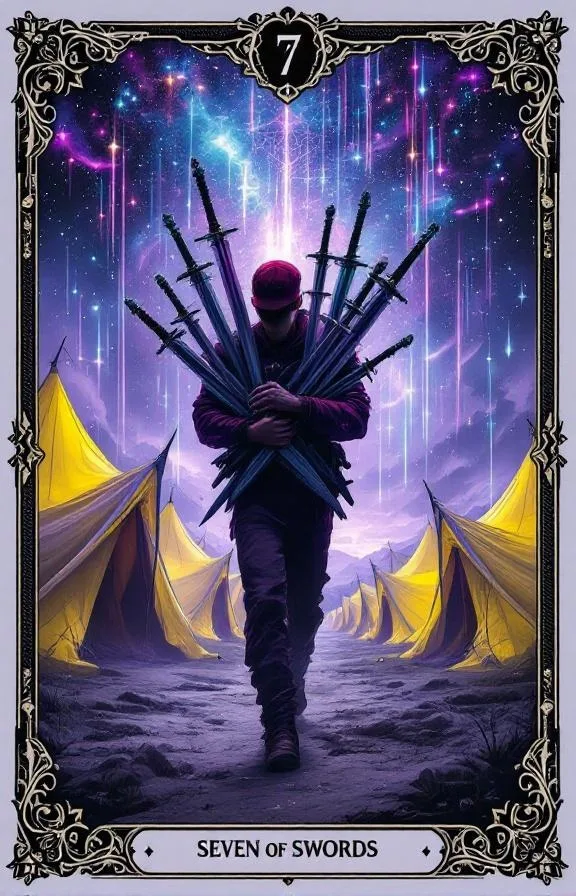
The upright Seven of Swords shows a figure sneaking away from a camp with five swords, leaving two behind. It is the card of strategy, cunning, and — depending on context — outright theft. The figure looks over their shoulder. They have gotten away with something. The plan worked.
When the card reverses, the plan stops working. Maybe the theft is discovered. Maybe the lie unravels because lies always require more lies to support them, and the architecture eventually collapses under its own weight. Maybe — and this is the version of the reversal that interests me most — nobody catches you at all. You catch yourself. The secret becomes heavier than the consequences of revealing it, and confession becomes the only way to put the weight down.
Hare developed the Psychopathy Checklist — a diagnostic tool for measuring traits associated with psychopathy, including superficial charm, pathological lying, and absence of guilt. What is often overlooked in popular discussions of his work is that he placed these traits on a continuum. Most people are not psychopaths. Most people experience guilt. The question is not whether guilt exists but how much deception a person's conscience can absorb before it rebels.
The Seven of Swords reversed marks the rebellion. Something you have been hiding — from others, from yourself, possibly both — has reached the limit of what your internal system can contain. The lid is coming off. Whether you remove it deliberately through confession or it blows off through exposure, the result is the same: what was hidden becomes known.
Seven of Swords reversed in love and relationships
This card in a love reading means someone is about to come clean. Or get caught. Often one triggers the other.
The most obvious reading is infidelity discovered. An affair that surfaces through a text left open on a screen, a receipt from the wrong restaurant, a friend who finally decides their loyalty lies with honesty rather than secrecy. The Seven of Swords reversed does not specify how the truth emerges — only that it does. And the specific pain of this card is not just the betrayal itself but the realization of how long the deception lasted. The affair hurts. Learning it went on for eight months while you trusted them absolutely — that is a different kind of hurt entirely.
But infidelity is not the only deception this card addresses. Smaller dishonesties accumulate. The partner who says "I'm fine" when they are not, week after week, until the distance between what is said and what is felt becomes a canyon neither person can cross. The person who hides financial decisions, spending, or debt from their partner. The relationship where both people pretend to be happy because the alternative — admitting they are not — would require changes neither is ready to make.
For single people, the Seven of Swords reversed frequently points to self-deception about what you actually want. You say you want commitment, but you keep choosing people who are unavailable. You say you are over your ex, but you compare everyone new to them. The card reversal is the moment this disconnect becomes impossible to ignore.
Here is the genuinely provocative take: sometimes the Seven of Swords reversed is a good card in a love reading. Confession, however painful, is an act of intimacy. Choosing to tell the truth when the lie is working — when nobody suspects, when you could get away with it indefinitely — is one of the bravest things a person can do in a relationship. It does not guarantee forgiveness. It does not fix the damage. But it establishes, in a way that nothing else can, that honesty matters more to you than comfort. Some relationships survive that. Some even strengthen because of it.
Seven of Swords reversed in career and finances
In professional contexts, the Seven of Swords reversed is the card of getting caught — or the card of choosing to stop before you do.
Workplace deception takes many forms, and this card covers all of them. Padding expense reports. Taking credit for someone else's work. Lying on a resume about a degree never completed. Manipulating metrics to make performance look better than it is. The upright Seven of Swords gets away with these things. The reversal does not.
The professional consequences of exposure tend to be swift and severe because professional relationships are built on a thinner foundation of trust than personal ones. A friend might forgive a lie because decades of shared history provide context. A business partner who discovers you have been misrepresenting numbers has no such context to fall back on. The relationship was transactional, the trust was specific, and the violation is therefore total.
Financially, the Seven of Swords reversed can indicate fraud coming to light — not necessarily yours. An accountant's "creative" bookkeeping discovered during an audit. A contractor who cut corners being exposed by an inspection. Investment returns that were fabricated. The financial face of this reversal is often other people's deception affecting your money, which is its own specific kind of violation.
There is a career dimension to this card that is less about deception and more about strategic retreat. If you have been working an angle at work — politicking, positioning, playing people against each other — the reversed Seven says the strategy has run its course. Either recalibrate toward transparency or prepare for the consequences of continuing. The window for plausible deniability is closing.
Seven of Swords reversed as personal growth
Hare's work focused on the extreme end of the conscience spectrum — people who genuinely do not experience guilt. But his research illuminated the opposite end just as clearly: people who experience guilt so intensely that they confess things they did not even do, who take responsibility for harms they did not cause, who carry secrets that are not even theirs to carry.
The personal growth dimension of the Seven of Swords reversed sits between these extremes. It asks a precise question: what are you hiding, and what is the hiding costing you?
Secrets consume psychological resources. This is measurable. Research on secret-keeping consistently shows that maintaining a secret requires active cognitive suppression, which depletes the same mental energy used for self-regulation, decision-making, and emotional processing. People keeping significant secrets perform worse on unrelated cognitive tasks. They report higher levels of fatigue. They get sick more often. The secret does not just sit passively in the mind. It demands constant maintenance, constant vigilance, constant energy directed toward making sure the truth stays contained.
The growth invitation of this card is elegant in its simplicity. Tell the truth. Not everything to everyone — that is its own form of dysfunction. But the specific truth you have been withholding from the specific person who needs to hear it. The thing you have rehearsed saying a hundred times and never said. The fact about yourself you manage through omission rather than disclosure. The confession you keep putting off because the timing never seems right. The timing will never seem right. The Seven of Swords reversed says tell it anyway.
There is a liberation in being known that cannot be accessed through any other means. Every secret is a wall, and every wall creates distance. Demolishing a wall does not guarantee that what is on the other side will welcome you. But living behind walls indefinitely guarantees a specific kind of loneliness that no amount of social contact can touch. The Seven of Swords reversed asks whether the protection the wall provides is still worth the isolation it creates.
How to work with Seven of Swords reversed energy
Confess before you are caught. The difference between voluntary confession and forced exposure is the difference between humility and humiliation. Both involve the truth coming out, but the first preserves agency and the second destroys it. If you are hiding something and the Seven of Swords reversed appears, take it as counsel: the truth is coming out regardless. You get to choose whether it comes from your mouth or from circumstances.
Examine your relationship with honesty itself. Not the principle of honesty — nearly everyone endorses that in the abstract. Your actual practiced relationship with truth-telling. When was the last time you told a difficult truth voluntarily? When was the last time you chose a comforting lie over an uncomfortable fact? These patterns are habitual, and habits can be changed, but only if they are first identified.
If you are on the receiving end of someone else's confession — if the Seven of Swords reversed in your reading points to someone else's deception being revealed — resist the urge to react immediately. The first reaction to betrayal is rarely the wisest. Anger is appropriate. It is also, in the first hours, undifferentiated — a blast that does not distinguish between the gravity of the offense and the courage of the confession. Give yourself time. Hare's spectrum of conscience is relevant here: the person who felt enough guilt to confess is, by definition, not at the pathological end of the continuum. That does not excuse what they did. It does inform how you respond.
Frequently asked questions
Does the Seven of Swords reversed mean someone is deceiving me right now?
It can, but the more common reading is that existing deception is ending. Secrets are surfacing, lies are being revealed, and hidden agendas are becoming visible. Whether you are the one being deceived, the one doing the deceiving, or both — the reversal says the era of concealment is closing. What replaces it depends on what everyone involved does with the truth once it is available.
Is this card connected to legal issues?
Sometimes. The Seven of Swords reversed can indicate legal consequences for dishonest behavior — contracts signed in bad faith, tax evasion discovered, fraud charges filed. If legal concerns are relevant to your situation, the card suggests that whatever has been done in the shadows is moving toward the light, and consulting a professional before that movement completes is wise.
What is the difference between the Seven of Swords reversed and The Moon?
The Moon deals with confusion, illusion, and things hidden in the subconscious — truths obscured by fear or self-deception that may not involve any deliberate dishonesty at all. The Seven of Swords reversed is specifically about conscious deception: lies told on purpose, secrets kept deliberately, strategies built on misleading others. The Moon is about what you cannot see. The Seven of Swords reversed is about what you chose to hide. When both appear together, expect the unraveling to be thorough — both the conscious deceptions and the unconscious illusions are dissolving simultaneously, which can feel like the entire floor disappearing.
Explore the Seven of Swords' full meaning, see what it reveals as feelings, or discover the Seven of Swords as a person. Ready for deeper insight? Try a free reading.