A chef I knew lost his restaurant in 2020. Not just the business — everything attached to it. His savings. His marriage, which had been held together partly by the shared project of the restaurant. His identity, because he had been "the chef" for twenty-two years and without the kitchen he did not know what sentence to use when people asked what he did.
Eighteen months later I ran into him at a farmers' market. He was selling hot sauce. Three varieties, hand-labeled, made in a commissary kitchen he rented for twelve hours a week. The operation was tiny. He was not making much money. But there was something in his face I had never seen during the restaurant years — a looseness, an absence of the clenched-jaw intensity that had defined him. "I lost everything," he said, "and then I found out everything wasn't actually that much." He laughed when he said it. Not bitterly. Like someone who had discovered a genuine secret.
That is the Ten of Swords reversed. Not the fall. The first morning after the fall, when you realize you survived it.
In short: The Ten of Swords reversed represents the beginning of recovery after total collapse — the moment when rock bottom becomes a foundation rather than a grave. Richard Tedeschi's research on post-traumatic growth demonstrates that catastrophic loss can catalyze profound positive transformation, not despite the suffering but through it, producing new priorities, deeper relationships, and an expanded sense of personal strength.
Why Ten of Swords appears reversed
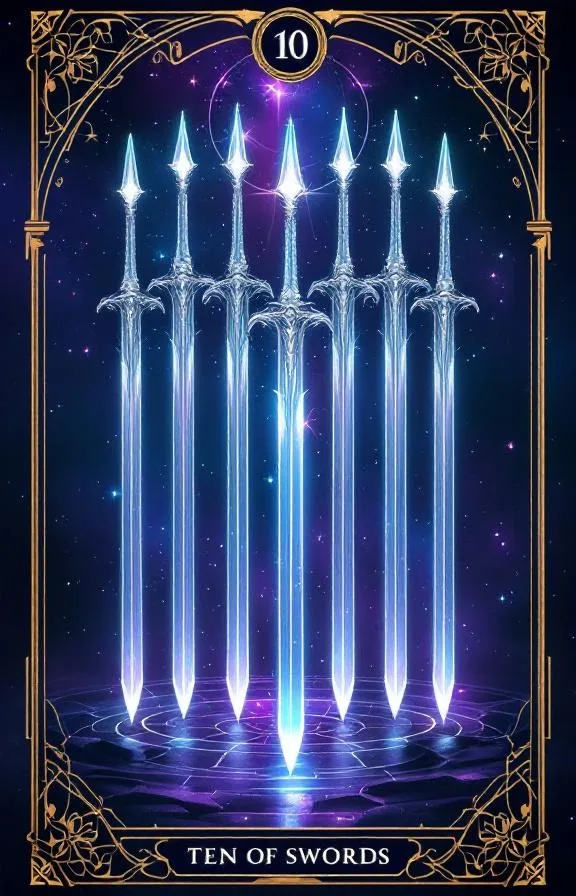
The upright Ten of Swords is arguably the most dramatic card in the tarot. A figure lies face-down with ten swords in their back. It is the end. Total. Final. Theatrical, even — and that theatricality matters. The upright card sometimes suggests that the situation, while painful, is not quite as catastrophic as it appears. The drama is part of the experience.
The reversal takes all of that theatrical finality and flips it. Literally. The figure is no longer face-down. The swords are still present — every wound, every betrayal, every loss — but the orientation has changed. Face-up. Looking at the sky. Breathing.
What Tedeschi documented across decades of research is that the most transformative growth often follows the most devastating experiences. Not minor setbacks. Genuine catastrophe. The loss of a child, a devastating diagnosis, the collapse of everything you built your life around. His data shows that a significant percentage of people who endure such events report — years later — that they are stronger, more compassionate, and more authentically themselves than they were before the event. This does not make the event good. It makes the human response to the event remarkable.
The Ten of Swords reversed holds this paradox without resolving it. You were destroyed. You are recovering. Both are true simultaneously.
Ten of Swords reversed in love and relationships
In love readings, this card usually appears after a relationship has already ended badly. The betrayal happened. The trust was broken. The thing you feared came true and you survived it. The reversed Ten is not about the ending — it is about what comes after.
If you are in the early stages of recovering from a devastating breakup, this card is the tarot's way of saying: the acute phase is ending. The calls at 2 AM, the obsessive checking of their social media, the replaying of conversations looking for the moment it all went wrong — that loop is starting to slow down. You may not feel it yet. Recovery from romantic devastation has a lag period. The change happens before you notice it, the way a fever breaks while you are sleeping.
For people who have been single for a long time after a painful relationship ending, the Ten of Swords reversed carries a different message. It says: you have kept those ten swords in your back by choice. The original wound healed long ago. What remains is your identification with the wound. "I am someone who was betrayed." "I am someone who cannot trust." These identities served a protective function. They are now keeping you from connection.
There is one reading scenario I want to address directly. If this card appears in a spread about an abusive relationship, it is not telling you to reconcile. It is telling you that the worst part — the part where you were in it — is over or ending. Recovery from abuse is not about forgiveness or moving on. It is about reclaiming territory. The Ten of Swords reversed says that reclamation has begun.
Ten of Swords reversed in career and finances
Career readings with the Ten of Swords reversed tend to follow a specific narrative: the failure already happened. The business closed, the contract fell through, the layoff came, the project imploded publicly. Whatever your professional worst-case scenario was, you lived it.
And you are still here.
That "still here" quality is the card's central message in career contexts. It does not promise immediate success or a new opportunity dropping into your lap. It promises something more fundamental: proof that professional failure is survivable. This sounds obvious. It is not. Most people who have never experienced significant career failure carry an unconscious belief that it would be fatal — not physically, but in terms of identity, reputation, self-worth. The Ten of Swords reversed appears for people who now know better.
Financially, this card sometimes signals the end of a debt crisis or bankruptcy process. The damage is done, the accounts are settled or discharged, and the rebuilding begins. It is a card of bare-bones clarity. When you have nothing left to lose, your financial decisions become remarkably clear. You stop making choices based on maintaining an image and start making them based on actual needs.
Ten of Swords reversed as personal growth
This is where Tedeschi's framework becomes genuinely illuminating. Post-traumatic growth is not resilience. Resilience is bouncing back to where you were. Post-traumatic growth is ending up somewhere you could not have reached without the devastation. Somewhere better, in certain specific ways, than where you started.
Tedeschi identified five domains where this growth manifests. Greater appreciation for life — the coffee really does taste better when you thought you would not make it. Deeper relationships — crisis strips away superficial connections and strengthens authentic ones. New possibilities — the chef selling hot sauce instead of running a restaurant. Personal strength — the knowledge, bone-deep and earned, that you can survive what you thought would destroy you. And spiritual or existential change — a shift in what you believe matters.
The Ten of Swords reversed does not guarantee all five. It does not guarantee any of them automatically. Growth after trauma is not inevitable. It requires engagement. You have to choose to build something from the rubble rather than sitting in it. The card says the raw material for transformation is available. Whether you use it is still up to you.
Here is my honest assessment: the Ten of Swords reversed is the most hopeful card in the Swords suit, and it only earns that hope by going through the worst the suit has to offer. There is no shortcut to this kind of strength. You cannot read about it and acquire it. You have to be flattened first.
How to work with Ten of Swords reversed energy
Do not rush. This is the single most important piece of advice for anyone working with this card's energy. The temptation after hitting bottom is to immediately start climbing — to prove to yourself and everyone else that you are fine, that you are bouncing back, that the experience did not break you. Resist this. The Ten of Swords reversed is about beginning, not completing. Give the beginning the time it needs.
Take an honest inventory of what you lost versus what you actually miss. These are often different lists. You might have lost a prestigious job and realize you do not miss the prestige at all — you miss the routine, or the commute, or the specific colleague you ate lunch with on Thursdays. Separating what was taken from what you genuinely valued helps you rebuild with intention rather than habit.
Find one person who has been through something similar and talk to them. Not a therapist — though therapy is valuable — but a civilian. Someone who can say "I know" and mean it. Tedeschi's research emphasizes that post-traumatic growth is often facilitated by narrative — the act of constructing a coherent story about what happened to you. Telling that story to someone who understands it accelerates the process.
Consider writing down the version of yourself that existed before the collapse. Not to grieve that person, but to see them clearly. What did they value? What did they ignore? What were they afraid of? You are becoming someone new. Understanding who you were helps you choose who that new person becomes.
Pay attention to what you are drawn to now that you were not drawn to before. Post-collapse, your priorities often rearrange themselves without conscious effort. The career that consumed you for a decade feels irrelevant. The hobby you dismissed as unserious suddenly feels like the most honest thing you do. These shifts are data. They are telling you what matters to the person you are becoming, as opposed to the person who was destroyed. Do not dismiss them because they do not match your old self-image. Your old self-image is the thing with ten swords in its back. It does not get a vote anymore.
One warning: well-meaning people will tell you that everything happens for a reason. This is one of the most damaging things anyone can say to someone recovering from genuine devastation. The Ten of Swords reversed does not claim your suffering had purpose. It claims that you, in the aftermath, have the capacity to create purpose from what remains. The difference is enormous. One implies the universe planned your pain. The other respects your agency in building something from it.
Frequently asked questions
Does the Ten of Swords reversed mean the situation will get better quickly?
Not quickly, no. It means the descent has stopped and the trajectory has shifted upward, but recovery from the kind of devastation the Ten of Swords represents takes time. Think months, not days. The card promises direction, not speed.
Can this card appear if nothing catastrophic has happened to me?
Yes. Sometimes the "rock bottom" is internal rather than external — a belief system that collapsed, an identity that shattered, a worldview that could not survive contact with reality. The external circumstances of your life might look unchanged while something foundational has shifted inside you.
Is the Ten of Swords reversed telling me to forgive the person who hurt me?
No. This card is about your recovery, not about the other person's absolution. Forgiveness may or may not be part of your process. The card does not prescribe it. It says: you survived what they did, and what you build next belongs entirely to you. That is the only message that matters here.
Explore the Ten of Swords' full meaning, see what it reveals as feelings, or discover the Ten of Swords as a person. Ready for deeper insight? Try a free reading.