The woman in the seat next to me on a flight from Chicago to Denver told me her entire divorce story in the time it took to reach cruising altitude. I did not ask. She just started talking somewhere over Iowa, as if the altitude made the conversation possible. What struck me was not the story itself — infidelity, a house they had just finished renovating, a daughter caught in the middle. What struck me was the moment she stopped mid-sentence, looked out the window at the clouds below us, and said: "I think I told you all that because it does not hurt the way it used to. I needed to check." She was testing her own wound. Pressing on a bruise to see if it had changed color.
That is the Three of Swords reversed. Not the wound itself. The moment you realize the wound is closing.
In short: The Three of Swords reversed represents the slow, uneven process of recovering from emotional pain — heartbreak loosening its hold, grief beginning to shift shape, sorrow becoming something a person carries rather than something that carries them. Bessel van der Kolk's research on trauma demonstrates that healing is fundamentally a body process: the pain has to move through, not just be understood. This card marks the phase when that movement finally begins.
Why the Three of Swords appears reversed
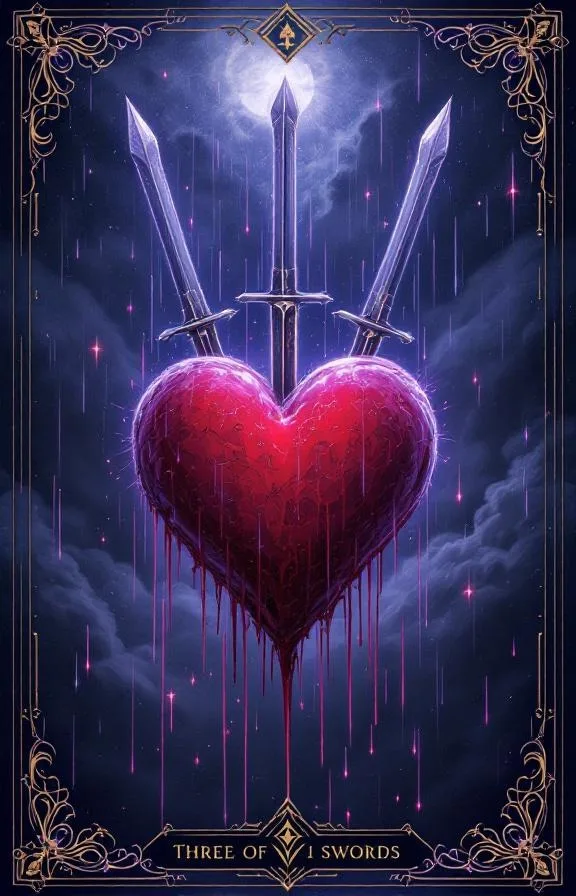
The upright Three of Swords is one of the most immediately recognizable images in tarot. Three blades through a heart. Rain. Clouds. Nothing ambiguous about it. When that image flips, something counterintuitive happens: the swords are withdrawing. Not gone — withdrawing. And the withdrawal of a blade can hurt almost as much as its entry.
This is a critical nuance. The Three of Swords reversed is not the end of pain. It is the beginning of the end of pain, and those are very different things. The beginning of healing often feels like a betrayal of the grief. You laugh at something funny and immediately feel guilty. You go an entire afternoon without thinking about the person you lost and then feel worse for having forgotten, even briefly. Van der Kolk described this as the body's nervous system recalibrating — it has been running a trauma program for so long that returning to baseline feels foreign, even threatening.
There is a shadow side to this reversal that deserves equal attention. Sometimes the Three of Swords reversed does not indicate healing in progress. It indicates healing refused. The person has become so identified with their pain that releasing it feels like losing a part of themselves. They have built an identity around being the one who was wronged, the one who suffered, the one who survived something terrible. The pain has become a story they tell at cruising altitude to strangers, and the story has replaced the actual experience.
Three of Swords reversed in love and relationships
In love readings, this card is almost always welcome. Almost.
If you are recovering from a breakup, the Three of Swords reversed confirms what you have been suspecting: the worst is behind you. Not over — behind you. You still think about them. You still have mornings where the emptiness on the other side of the bed registers before the alarm does. But the thoughts have changed quality. They are memories now, not open wounds. You can drive past the restaurant without your chest tightening. You can hear their name without your stomach dropping. These are small victories, and the Three of Swords reversed says they are real.
For people in relationships, this card sometimes appears after a significant betrayal that both partners chose to work through. An affair that was disclosed and addressed. A lie that was uncovered and forgiven. The card does not say the forgiveness is complete. It says the forgiveness is underway, that the couple has chosen to rebuild rather than demolish, and that the choice is holding. Barely, sometimes. But holding.
The shadow version in love readings looks like this: you have not actually forgiven. You said you did. You went to therapy. You performed the motions of reconciliation. But somewhere underneath, the betrayal is still the first thing you think about when they are late coming home, still the lens through which you interpret their silences. The Three of Swords reversed asks — gently, but asks — whether you are healing or rehearsing.
There is an unpopular truth buried in this card. Some heartbreaks should not be gotten over quickly. Some pain is proportional to what was lost, and rushing past it dishonors the thing that mattered. If someone you loved deeply is gone, and it has been three months, and people are telling you to move on — the Three of Swords reversed gives you permission to grieve at your own pace. Healing has a timeline. It is just not anyone else's to set.
Three of Swords reversed in career and finances
Professionally, this reversal often marks the aftermath of a significant professional disappointment. A project that failed. A promotion that went to someone else. A business that did not survive. The acute sting has faded, and what remains is a quieter question: what did this cost me, and what did it teach me?
The career dimension of this card tends to be less dramatic than the love dimension. Work grief is real but usually less total — you did not build your entire identity around that quarterly report. Usually. For people who did — founders whose startups failed, artists whose work was rejected publicly, academics who did not get tenure — the Three of Swords reversed in a career reading carries the same weight as in a love reading. The loss was personal enough to wound personally.
Financially, the card sometimes appears during recovery from a significant monetary loss. A bad investment. A business debt that required years to pay off. A period of unemployment that depleted savings built over a decade. The reversed position says the financial bleeding has stopped, even if the account has not refilled. Stability is returning, slowly and incompletely, but returning.
Three of Swords reversed as personal growth
Van der Kolk's most important contribution to trauma research was the insight that trauma is stored in the body, not just the mind. Talk therapy helps — he never disputed that. But understanding why you feel pain does not automatically make the pain stop. The body has its own memory, its own timeline, its own conditions for release. The Three of Swords reversed aligns with this perspective perfectly. It marks the point where something in the body shifts, where the grief that has been held in tight shoulders or a clenched jaw or a chest that never quite fully expands begins, fractionally, to loosen.
The personal growth edge of this card is about relationship with suffering. Western culture tends to frame suffering in binary terms: you are either in pain or you are healed. The Three of Swords reversed suggests a third state — a state where pain and recovery coexist, where you are simultaneously wounded and healing, where the scar is forming even as the area remains tender. Learning to inhabit this state without rushing toward either extreme is the card's primary teaching.
Practically speaking, this looks like allowing yourself to have a good day without interpreting it as evidence that you should be over it. It also looks like allowing yourself to have a bad day without interpreting it as evidence that no progress has been made. Healing is not linear. Van der Kolk would add that it is not purely cognitive either — the body heals through movement, through breath, through the slow reestablishment of safety in the nervous system. The Three of Swords reversed supports anything that helps the body feel safe again. Yoga. Long walks. Being held by someone you trust. These are not supplements to the real work of healing. They are the real work.
How to work with Three of Swords reversed energy
Stop measuring your recovery against someone else's timeline. This is the single most important thing. Your mother got over her divorce in six months. Good for her. Your friend was dating again three weeks after his breakup. Good for him. Your timeline is yours, and the Three of Swords reversed is telling you that your timeline is working, even if it looks nothing like anyone else's.
Practice what grief researchers call "oscillation" — moving deliberately between engaging with the loss and engaging with life. Spend time sitting with the pain. Then go do something that has nothing to do with the pain. Cook something elaborate. Watch a comedy. Call a friend and talk about their life instead of yours. The oscillation itself is therapeutic. It teaches the nervous system that grief and joy can share the same day.
If you find yourself unable to let the pain go — if the wound has become your identity, if being the wronged one is now central to how you present yourself — the card is asking you to consider what you gain by staying wounded. This is not victim-blaming. The wound was real. The betrayal happened. But at some point, the story of the wound starts serving a function that the wound itself no longer serves, and recognizing that function is the doorway to actual release.
Frequently asked questions
Does the Three of Swords reversed mean I am fully healed?
No. It means healing has begun or is well underway. Full healing is a longer process, and this card specifically represents the messy middle — the phase where pain and recovery overlap. Think of it as the moment a fever breaks. You are not healthy yet, but the worst has passed.
Can this card indicate a new heartbreak coming?
Rarely. In most contexts, the Three of Swords reversed looks backward, not forward. It addresses pain that has already occurred and is now in the process of releasing. If a new heartbreak were incoming, you would more likely see the upright Three of Swords, the Tower, or a challenging combination involving the Five of Cups.
I keep pulling this card. What does repeated appearance mean?
Repetition with this card usually means the healing process is taking longer than you want it to, and the cards are acknowledging that rather than rushing you. It can also mean you are cycling — making progress, then retreating into the pain, then making progress again. That cycle is normal. Van der Kolk would call it the nervous system doing exactly what nervous systems do when processing something significant. The repeated card is not a warning. It is a companion, showing up to say: still here, still healing, still worth the patience.
Explore the Three of Swords' full meaning, see what it reveals as feelings, or discover the Three of Swords as a person. Ready for deeper insight? Try a free reading.